
Process design
HRT, organic loading and working volume: three checks for digester sizing
Why a tank diameter or a standard retention period cannot establish whether a proposed digester is correctly sized.
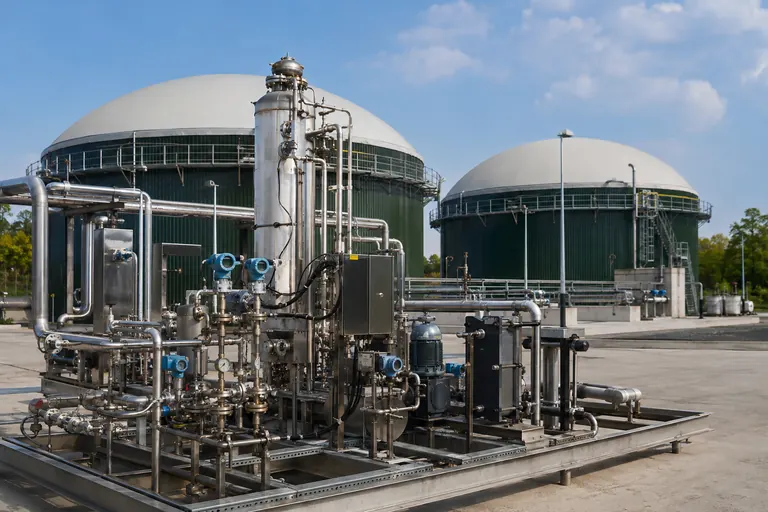
Define the volume that actually participates
A tank's gross geometric volume includes space that may not be part of the operating liquid inventory. Working levels, freeboard, internal structures and expected settled material affect the usable process volume. The calculation should be tied to drawings and the intended operating range.
For a cylindrical section, geometric volume is π × diameter² × liquid depth ÷ 4. This arithmetic is only the starting point. The designer must establish the working liquid depth and account for the actual tank configuration before using the result in process calculations.
Check hydraulic retention time
Hydraulic retention time (HRT) relates the liquid inventory to the relevant throughflow. The process boundary matters: fresh feed, dilution water and return streams need to be identified consistently. An internal circulation flow should not automatically be added as new feed leaving the system.
Worked example: an illustrative working volume of 6,000 m³ receiving a net external slurry throughflow of 150 m³/day has an apparent HRT of 40 days. A different return-flow boundary or actual liquid inventory changes that result. Forty days is a calculated example, not a universal design requirement.
Check the organic load independently
Organic loading rate (OLR) relates the daily organic input to working volume. On a VS basis, the unit is kg VS/m³/day. Two slurries with the same volume can carry different organic loads if their solids or organic fractions differ. HRT alone therefore does not define the biological duty.
Worked example: 12,000 kg VS/day entering 6,000 m³ gives 2.0 kg VS/m³/day. This calculation does not establish that the feed is suitable at that loading. The operating limit depends on degradability, temperature, inhibition risk, process configuration and supporting evidence.
Connect process sizing with practical operation
The selected volume must also work with mixing, heat distribution, feeding and maintenance. Poorly mixed zones, sediment or floating layers can make the effective process behaviour different from the nominal calculation. Feed preparation and liquid balance therefore belong in the same design review.
A design note should state the feed quantities, TS/VS basis, liquid additions and removals, working volume and the evidence used to select operating conditions. Sensitivity to changed feed moisture and availability should be visible. This makes the design reviewable and exposes assumptions that require testing before a performance commitment.
- Show gross, operating and effective volume assumptions separately.
- Define the mass and hydraulic boundaries of every return stream.
- Calculate both HRT and OLR using compatible inputs.
- Avoid transferring a laboratory BMP result directly into a retention-time guarantee.
Evidence & further reading
Source material
- IEA Bioenergy Task 37: Process monitoring in biogas plants
- US EPA AgSTAR: Project Development Handbook
- Koch et al. (2020): Power and limitations of biochemical methane potential tests
Technical references inform the discussion. Final design, operating limits and policy eligibility depend on the project and applicable current documents.