
Feedstock & biology
From a BMP test to a credible plant production estimate
How to read methane-potential results, reconcile solids and avoid turning a laboratory result into an unsupported production guarantee.
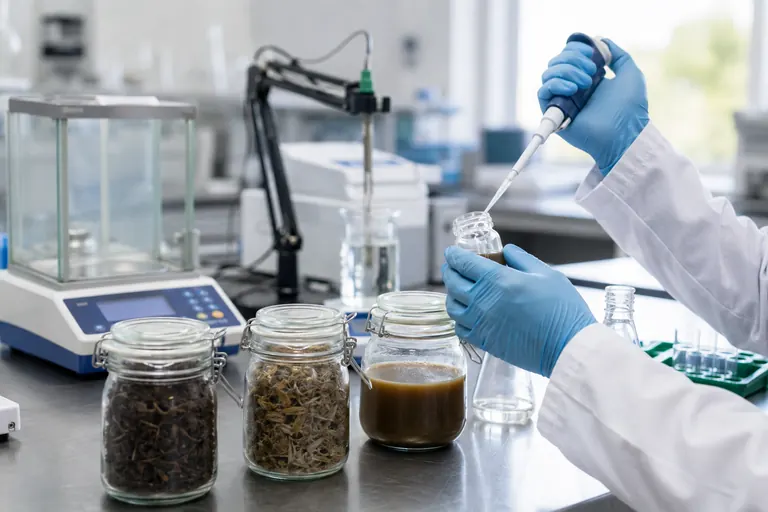
Start with the reporting basis
A biochemical methane potential (BMP) result is useful only when its denominator is clear. Methane volume per kilogram of volatile solids is different from methane volume per tonne of wet feed. Total solids (TS) describe the dry fraction of a sample; volatile solids (VS) describe the organic fraction within that dry material. Moisture and mineral contamination can therefore change the methane potential of a delivered wet tonne even where the reported VS-based BMP remains unchanged.
Check whether the reported gas is dry and normalised, which temperature and pressure convention is used, and whether the value represents methane or total biogas. The test report should identify the sample, preparation, method, blanks, controls and the basis of the final result.
Convert the units before comparing materials
Worked example: a hypothetical feed contains 25% TS, of which 80% is VS. One wet tonne therefore contains 1,000 × 0.25 × 0.80 = 200 kg VS. At an illustrative measured BMP of 0.30 Nm³ methane/kg VS, its laboratory potential is 60 Nm³ methane per wet tonne. These are teaching assumptions, not a Napier yield recommendation.
If an otherwise comparable delivery contains only 20% TS, it contains 160 kg VS per wet tonne on the same VS/TS assumption. The corresponding calculated laboratory potential is 48 Nm³ per wet tonne. A wet-tonne price alone does not show the difference in energy value or transport efficiency.
Keep laboratory potential separate from plant output
BMP testing is a batch assessment under defined laboratory conditions. Full-scale operation introduces retention time, loading, mixing, feed variability and process stability. Koch and co-authors discuss why BMP results should not be used to establish continuous-reactor performance or co-digestion benefits without further evidence.
The production model needs a justified conversion assumption and a separate gas-recovery and availability basis. Upgrading losses, off-spec gas, flaring, maintenance and delivery constraints come after biological methane generation. Applying a single unexplained percentage to cover all of these obscures where the uncertainty lies.
Use testing to answer a specific decision
Sampling should reflect the feed that will be delivered, including its seasonal condition and any proposed storage or preparation step. A selected fresh sample may not represent aged stock or a mixed supplier stream. Where a novel recipe or difficult material is central to the project, more representative sampling and continuous trials may be justified.
- Request TS, VS and the methane yield with clearly stated units.
- Keep raw laboratory results separate from design conversion assumptions.
- Test the actual proposed material and preparation route.
- Compare delivered cost per usable energy unit as well as per wet tonne.
- Document the evidence supporting any contractual output commitment.
Evidence & further reading
Source material
- Koch et al. (2020): Power and limitations of biochemical methane potential tests
- IEA: Sustainable potential and cost of biogas feedstocks
Technical references inform the discussion. Final design, operating limits and policy eligibility depend on the project and applicable current documents.