
Plant energy
Solar for a CBG plant: calculate self-consumption before savings
Why load timing, land use, export rules and the connection design matter as much as the proposed solar capacity.
Begin with the hourly load
A CBG plant can consume electricity around the clock, while solar output varies with daylight and weather. The assessment should identify which loads run during solar hours, which cycle and which may be unavailable during maintenance. Annual electricity consumption alone cannot establish the optimum solar capacity.
For an existing site, interval meter data provides a stronger starting point than a motor list. For a proposed site, develop a load schedule from equipment duty and operating hours, then test it against the commissioning and expansion plan.
Separate generated energy from useful energy
Estimate solar generation using site weather, orientation, shading and loss assumptions. Then match that production to the plant's load profile. Energy consumed on site, exported, curtailed or sent to storage must be accounted for separately.
Worked example: an illustrative month with 100,000 kWh solar generation and 75,000 kWh consumed directly by the plant has 25,000 kWh that needs another permitted use. Valuing all 100,000 kWh at the avoided retail tariff would be incorrect if exported or curtailed energy has a different value.
Treat the ground layout as part of the plant
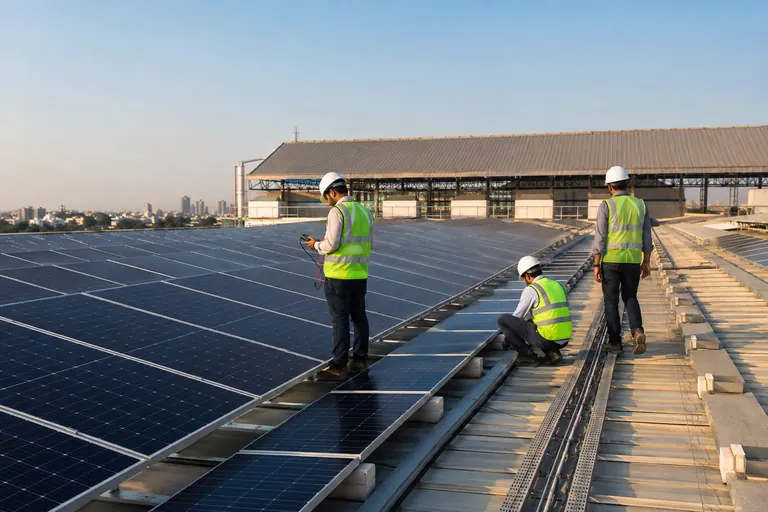
Available land is not the same as usable solar area. Access roads, drainage, shading, cable routes and future process expansion can reduce the practical array footprint. On a new CBG site, the solar proposal should be coordinated with the complete master plan.
The electrical study should establish the connection point, voltage, protection, cable route and any grid-approval requirement. Model estimates are useful for screening, but an equipment quotation or an annual production number does not replace these interface checks.
Use a savings model that reflects the agreement
The commercial case should identify the actual tariff avoided, export treatment, operating costs, degradation, replacement assumptions and financing structure. Check the applicable state and distribution-company requirements before relying on export or net-metering revenue. Rules from a residential scheme should not be applied automatically to an industrial plant.
A normal grid-connected solar installation does not automatically supply the plant during a grid outage. If continuity of power is a requirement, the backup or storage arrangement needs its own design and economic review.
- Compare the generation curve with the plant's daytime minimum load.
- Value self-consumed and exported energy separately.
- Reserve access and future plant expansion in the layout.
- Document weather, losses, tariff and approval assumptions.
Evidence & further reading
Source material
- US Department of Energy: Solar potential and PVWatts estimation
- US EPA AgSTAR: Project Development Handbook
Technical references inform the discussion. Final design, operating limits and policy eligibility depend on the project and applicable current documents.