
The engineering context
What determines the right system
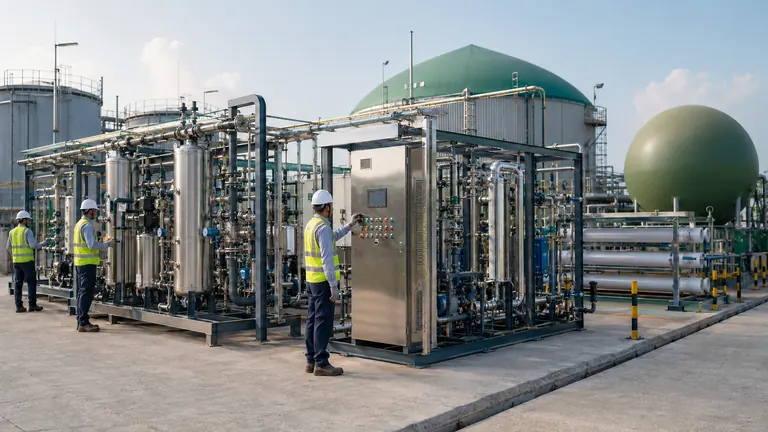
Vacuum pressure swing adsorption separates gases by cycling adsorbent beds through adsorption and regeneration conditions. The complete package includes much more than the vessels: inlet treatment, switching valves, vacuum duty, controls and residual-gas handling determine how the system performs over time.
The equipment comparison needs a common raw-gas basis and a common product boundary. Methane purity describes composition, while methane recovery describes how much inlet methane is retained. A high-purity product can still be accompanied by material methane loss if recovery and off-gas handling are not properly assessed.
What to request in a VPSA offer
| Parameter | Specify or measure | Why it matters |
|---|---|---|
| Inlet envelope | Flow basis, methane, H₂S, moisture and operating pressure | Defines the conditions under which the guarantee applies |
| Product quality | Composition, moisture and buyer-specific limits | Establishes saleability at the delivery interface |
| Methane recovery | Inlet and product methane balance on matching conditions | Separates gas quality from retained fuel quantity |
| Specific electricity | Whole-package kWh per agreed gas or product unit | Prevents comparison of different package boundaries |
| Operating flexibility | Turndown, restart, maintenance and off-gas response | Tests suitability for real plant operation |
Altpreneur scope
From specification to commissioning
Gas basis
Confirm dry or wet flow basis, pressure, temperature, methane fraction, contaminants, operating hours and turndown. The daily gas volume must be reconciled with the purification window.
Process integration
Coordinate H₂S and moisture protection, adsorption vessels, valves, vacuum equipment, recycle arrangements and off-gas treatment with the selected vendor process.
Measurement
Agree the locations and accuracy of flow, pressure, temperature and gas-quality measurements. Define purity and methane recovery independently.
Site commissioning
Plan utilities, foundation interfaces, access, leak testing, interlocks, process tuning and performance verification.
Decisions worth getting right
Reconcile daily and hourly duties
Illustrative sizing: 10,000 Nm³/day processed over 18 hours requires about 556 Nm³/h before any allowance for peaks or availability. This arithmetic does not specify an adequate storage volume or a guaranteed CBG output.
Protect the adsorbent
The chosen vendor's contaminant and moisture limits govern the pretreatment design. Replacement life cannot be meaningfully compared without a stated inlet quality and operating history.
Include residual-gas treatment
A methane balance should account for product, recycle, residual gas and losses. The appropriate residual-gas treatment is part of the environmental and process design.
Assignment outputs
What you receive
- Gas and utility design basis
- Vendor specification and package boundaries
- Installation and interface review
- Agreed gas-quality and recovery test protocol
To begin
Useful starting information
- Raw-gas flow and analysis
- Required delivery quality and pressure
- Daily operating hours and available utilities
Scope and responsibility
Product purity, recovery and energy use depend on the chosen process and feed conditions. No catalogue number substitutes for a project-specific guarantee.
Common questions
Does high methane purity prove high recovery?
No. Purity describes the product composition; recovery describes the fraction of inlet methane retained in the product. Both need separate measurements.
How is hourly capacity selected?
Divide the design daily raw-gas volume by the planned processing hours, then review peaks, turndown, storage and availability margins.
Evidence & further reading
Source material
- Andlar et al. (2021): Biogas production systems and upgrading technologies
- IEA: Key issues affecting biogas and biomethane projects
Technical references inform the discussion. Final design, operating limits and policy eligibility depend on the project and applicable current documents.