
Project economics
How to compare CBG project budgets
How to compare EPC offers and identify costs that can sit outside the quoted plant package.
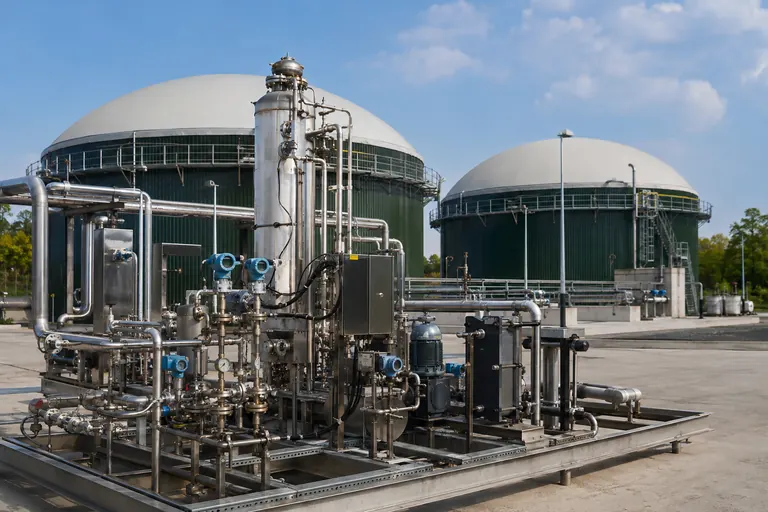
Compare equivalent scopes
Two offers for a plant with the same daily CBG capacity may cover different facilities. One may include substantial seasonal storage, digestate treatment and internal electrical works; another may leave them to the owner. Prepare an inclusion and exclusion schedule before treating the price difference as a saving.
Identify costs outside the process package
Separate the EPC package from the total project funding requirement. Land, offsite connections, gas transport assets, statutory costs, financing during construction and working capital may sit outside the vendor quote. Taxes and recoverable credits require their own treatment; a credit should not be presented as operating sales income.
- Civil, mechanical, piping, electrical and controls packages
- Installation, testing, commissioning and start-up inputs
- Client-supplied equipment, utilities and gas logistics
- Contingency, financing and working capital
Measure cost against saleable output
A plant's daily cash cost divided by actual saleable kilograms is a useful operating measure. Nameplate capacity can hide the effect of downtime or low yield. A lower capital price may produce a higher cost per kilogram if it leaves a persistent bottleneck or unreasonable maintenance burden.
Test the downside
Build a base case and downside cases for feedstock cost, usable supply, gas conversion, plant availability and net realisation. Test delayed construction or incentive receipts against financing headroom. Use current quotations and the actual proposed contract for investment decisions; this article provides a comparison method rather than a market-price estimate.
Translate operating assumptions into a cost per saleable kilogram
Separate costs that follow production from costs that continue during a stoppage. Feedstock, some consumables and dispatch may vary with output; staffing, finance and parts of maintenance do not fall in the same proportion. A lower-output case should reflect this rather than reducing every expense automatically.
The denominator is saleable CBG over the period, with agreed treatment of off-spec gas and losses. Keep the same cost boundary when comparing proposals. A process-only kWh/kg figure should not be compared with a whole-site electricity bill.
Show cash timing as well as total cost
A funding schedule should include advance payments, manufacture, civil work, delivery, installation, commissioning, working capital and any expected support payment. Credit terms and seasonal feedstock purchases can create cash peaks that do not appear in an annual profit statement.
Sensitivity cases should examine linked risks: higher feed cost with poorer availability, delayed commissioning with interest during construction, or reduced output with unchanged fixed costs. Record the assumptions and the conditions that would cause the project to be resized, renegotiated or deferred.
Evidence & further reading
Source material
Technical references inform the discussion. Final design, operating limits and policy eligibility depend on the project and applicable current documents.