
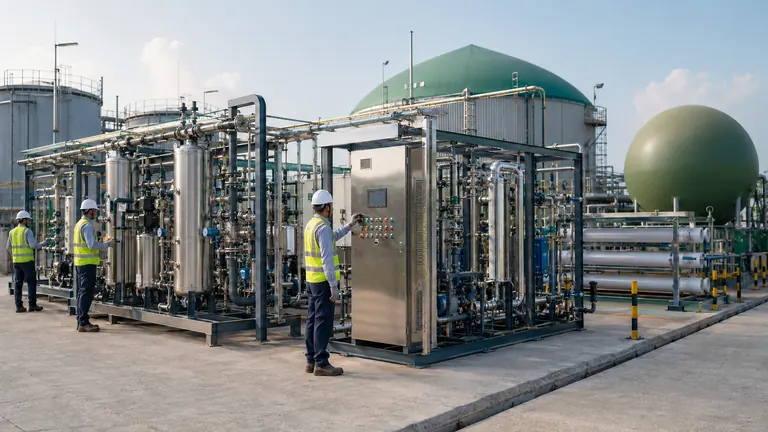
The engineering context
What determines the right system
The front end determines what material actually reaches the biological process. Reception, contamination removal, size reduction, mixing and transfer must work as a sequence. Increasing the rated capacity of one machine does not remove a bottleneck in the following tank, pump or pipe.
Duty is selected around the available feeding window and the actual material. Wet tonnes, dry matter and loose bulk volume are different bases. A handling line that works with a uniform demonstration sample may need a different arrangement for long fibres, stones, variable moisture or irregular delivery batches.
Match equipment to the material and schedule
| Step | Duty to define | Reliability concern |
|---|---|---|
| Reception | Peak vehicle arrivals, weighing and unloading cycle | Queues and inconsistent feed availability |
| Separation | Expected stones, metal, grit and packaging | Damage to cutters, pumps and digesters |
| Size reduction | Particle distribution, fibre and actual hourly throughput | Wear, power demand and maintenance access |
| Mixing | Working volume, solids, dilution and batch sequence | Unmixed pockets and difficult pump suction |
| Transfer | Flow, total head, solids passage and line arrangement | Blockage, cavitation and incorrect pump selection |
Altpreneur scope
From specification to commissioning
Receiving and removal
Plan weighing and reception with appropriate separation of stones, grit, metal and other unwanted material before sensitive equipment.
Preparation
Select shredding, maceration or other treatment against particle properties, digestibility objectives, energy demand and wear.
Mixing and transfer
Check working volume, rheology, suction conditions, line losses and blockage risks. Pump selection needs the actual duty and material properties.
Operating continuity
Provide access for cleaning and maintenance, defined stoppage arrangements and measured feed delivery to the digestion process.
Decisions worth getting right
Translate the shift plan into hourly capacity
A 90-tonne daily wet-feed requirement over 12 hours averages 7.5 tonnes/hour. Peak receiving, cleaning interruptions and equipment availability must be assessed in addition to that arithmetic.
Test pretreatment against net benefit
Finer preparation can help handling or conversion, but the gain must be compared with electricity, wear, chemicals where used and any change in downstream stability.
Provide recovery from a stoppage
Define safe cleaning access, isolation, temporary buffering and the response to unavailable equipment. A nominally adequate line can still be unreliable without these arrangements.
Assignment outputs
What you receive
- Material-handling and hourly-duty basis
- Equipment and transfer specifications
- Layout and maintenance interfaces
- Commissioning and feed-measurement plan
To begin
Useful starting information
- Wet feed quantity, solids, fibres and contaminants
- Feeding hours and storage arrangement
- Pump routes, elevations and receiving layout
Scope and responsibility
A machine's nominal throughput is conditional on feedstock properties. Vendor trials may be needed for difficult fibrous or variable materials.
Common questions
Why does a 12-hour feed window change machine capacity?
The daily feed must pass through the front end in fewer hours. Hourly duty, buffering and reliability must therefore be assessed together.
Does finer shredding always improve plant economics?
Any gas-yield or handling benefit must be weighed against electricity, maintenance and wear. The optimum depends on the material and process.
Evidence & further reading
Source material
- US EPA AgSTAR: Project Development Handbook
- US EPA AgSTAR: Anaerobic Digester/Biogas System Operator Guidebook
- Koch et al. (2020): Power and limitations of biochemical methane potential tests
Technical references inform the discussion. Final design, operating limits and policy eligibility depend on the project and applicable current documents.