
The engineering context
What determines the right system
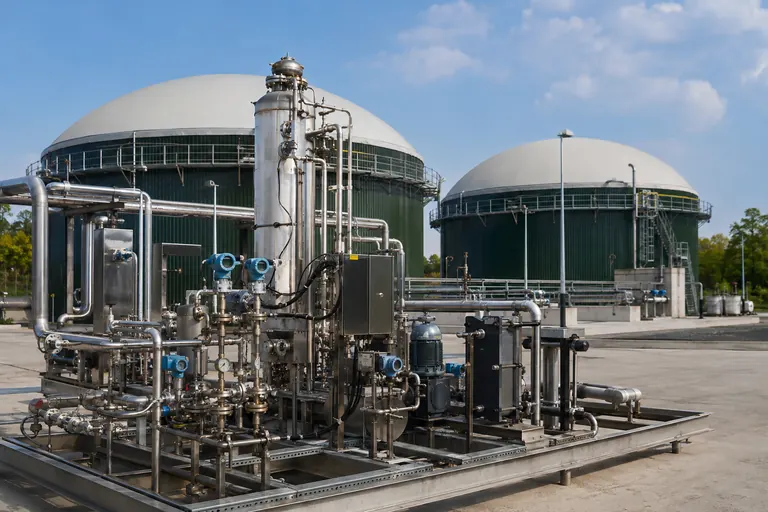
Membrane upgrading uses differences in gas permeation to separate a methane-rich stream from the carbon-dioxide-rich stream. Pressure, membrane staging and recycle influence product quality, methane recovery and compression duty. A modular skid still requires a complete assessment of inlet treatment and downstream delivery.
For procurement, compare the supplied system at its declared feed conditions and operating range. Membrane area or stage count alone is not a performance specification. The proposal should explain its contaminant limits, monitoring, element replacement assumptions and the treatment of methane remaining in residual gas.
Compare complete upgrading packages
| Comparison | Question for the supplier | Decision impact |
|---|---|---|
| Pretreatment | Which contaminants and concentrations are excluded from the guarantee? | Additional removal stages and consumables |
| Compression | What inlet pressure and discharge conditions are assumed? | Electrical demand and compressor scope |
| Stages and recycle | How are purity and recovery maintained across the flow range? | Flexibility, power and methane retention |
| Maintenance | What replacement basis, support and spares are included? | Lifecycle cost and outage duration |
| Acceptance | Which flows and compositions are measured, and for how long? | A fair comparison with VPSA or other technologies |
Altpreneur scope
From specification to commissioning
Pre-treatment
Establish allowable contaminants and the protection needed for membranes and compressors. Include condensate handling, filtration and replacement access.
Separation arrangement
Evaluate pressure, membrane stages, recycle and turndown against purity, recovery and power objectives.
Off-gas management
Quantify methane leaving with residual gas and specify the appropriate recovery or treatment approach.
Operating support
Review monitoring, consumable life, vendor support, spare elements and acceptance-test conditions.
Decisions worth getting right
Keep comparisons like for like
Compare equal inlet gas, outlet specification, annual operating profile and utility boundaries. A price comparison between partial packages gives an incomplete answer.
Plan access and consumables
Filters, treatment media, compressor parts and membrane elements need a procurement and maintenance plan. Imported component lead times can matter more than a small initial price difference.
Review off-design operation
Ask how the system handles reduced gas availability, composition changes and an unavailable downstream compressor. These conditions should be included in the controls and operating review.
Assignment outputs
What you receive
- Package specification and comparison
- Pre-treatment and utility interfaces
- Controls and gas-quality measurement requirements
- Commissioning and operating handover scope
To begin
Useful starting information
- Raw-gas analysis including relevant trace contaminants
- Flow range and operating schedule
- Product pressure and offtake specification
Scope and responsibility
Membrane technology is not automatically the best choice for every plant. The comparison must use equivalent gas quality, recovery and lifecycle assumptions.
Common questions
Should membrane and VPSA offers be compared only by price?
No. Compare recovery, energy use, maintenance, pre-treatment, operating flexibility and the same performance-test conditions.
Can the package accept untreated biogas?
The vendor's inlet limits govern. Uncontrolled moisture, particulates or contaminants can damage equipment and reduce performance.
Evidence & further reading
Source material
- Andlar et al. (2021): Biogas production systems and upgrading technologies
- IEA: Key issues affecting biogas and biomethane projects
Technical references inform the discussion. Final design, operating limits and policy eligibility depend on the project and applicable current documents.